


Optical Properties, Performance, and Laboratory Applications
Introduction
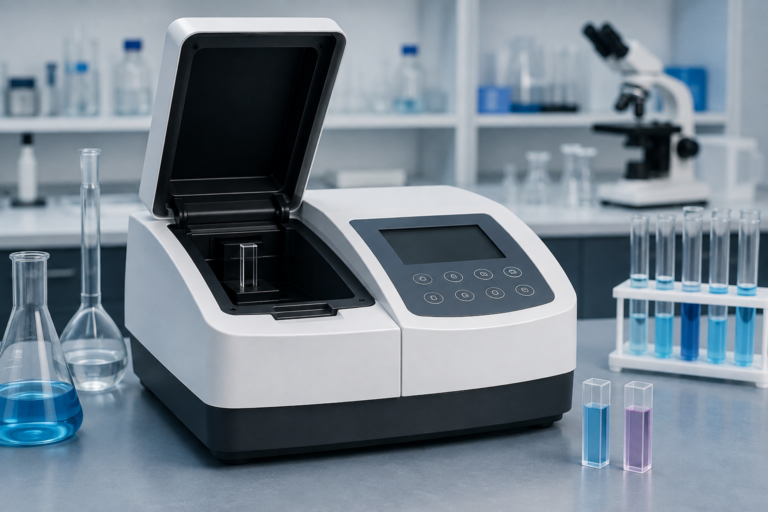
Cuvette quartz refers to a laboratory sample cell manufactured from high-purity quartz glass and designed for precise spectroscopic measurements. Laboratories use these cuvettes in UV, visible, and fluorescence spectroscopy because quartz provides excellent optical transmission and chemical stability. Researchers prefer cuvette quartz when experiments require accurate light passage at short wavelengths where standard glass or plastic materials fail to perform reliably.
Material characteristics of Quartz
Quartz exhibits superior optical clarity across a broad spectral range, typically from the deep ultraviolet to the near infrared. Unlike regular glass, quartz does not significantly absorb UV radiation, which makes it essential for measurements below 320 nm. Its low thermal expansion, high chemical resistance, and mechanical stability also allow consistent performance under demanding laboratory conditions. These characteristics position cuvette quartz as the preferred choice for high-precision optical analysis.
Role of Cuvette Quartz in spectroscopy
Cuvette quartz plays a critical role in spectroscopic accuracy because the sample container directly affects light transmission and signal quality. The material minimizes background absorption and reduces optical interference, ensuring that detectors measure the true absorbance or emission of the sample. In UV-Vis spectroscopy, even small impurities or surface defects can distort results, so high-quality cuvette quartz improves reliability and reproducibility.
Design and structural features
Manufacturers produce cuvette quartz with polished optical windows, strict dimensional tolerances, and defined path lengths, commonly 1 mm, 5 mm, or 10 mm. The path length determines how far light travels through the sample and directly influences absorbance calculations. Precision polishing reduces scattering and reflection, while tight tolerances ensure consistent measurements between different cuvettes in comparative experiments.
Common laboratory applications
Cuvette quartz supports a wide range of analytical tasks. Scientists use it for protein quantification, nucleic acid analysis, enzyme kinetics, chemical concentration measurements, and fluorescence assays. In pharmaceutical and biochemical research, the material enables detection of subtle spectral changes that indicate molecular interactions or structural transitions. These applications require the optical performance that only cuvette quartz consistently delivers.
Advantages over glass and plastic alternatives
Compared with plastic or standard glass cuvettes, cuvette quartz provides broader wavelength compatibility, higher durability, and better resistance to solvents and acids. Plastic cuvettes offer convenience and low cost but often absorb UV light and scratch easily. Glass cuvettes handle visible wavelengths but limit UV measurements. Cuvette quartz overcomes both limitations and supports demanding analytical protocols.
Handling and maintenance considerations
Proper handling preserves the optical quality of cuvette quartz. Users should avoid touching optical surfaces, clean the cuvette with suitable solvents, and store it in protective cases. Scratches, residues, or fingerprints can introduce light scattering and measurement errors. Regular inspection and careful cleaning maintain consistent analytical performance.
Quality and selection criteria
When selecting cuvette quartz, laboratories should consider optical grade, path length accuracy, chemical compatibility, and manufacturing standards. High-quality cuvettes often include certification of transmission properties and dimensional precision. Choosing reliable products ensures reproducible data and reduces experimental variability.
Role in modern analytical laboratories
Cuvette quartz remains a fundamental component of spectroscopic workflows in research, clinical, and industrial laboratories. Its combination of optical transparency, chemical resistance, and structural precision supports accurate and repeatable measurements across diverse scientific fields. As analytical methods become more sensitive, the importance of high-quality cuvette quartz continues to grow.
Conclusion
Cuvette quartz provides the optical and chemical performance required for advanced spectroscopic analysis. By ensuring minimal interference and maximum transmission, it enables precise detection and quantification of samples. For laboratories that demand reliable and reproducible results, cuvette quartz represents a critical and professional standard in experimental practice.