
What It Is, How It Works, and How to Choose the Right One
In UV-Vis spectroscopy and optical laboratory analysis, the quality of the measurement depends not only on the instrument itself, but also on the sample holder used during the analysis. For users searching for Cuuvette quartz, the correct professional term is quartz cuvette, one of the most important components in this process.
A quartz cuvette is a transparent optical cell designed to hold liquid samples during spectrophotometric measurements. It allows light to pass through the sample while the instrument measures absorbance, transmittance, or other optical properties. Because quartz offers excellent optical transmission in the ultraviolet and visible ranges, quartz cuvettes are widely used in analytical chemistry, pharmaceutical quality control, biotechnology, environmental testing, and research laboratories.
Although some users may search for the term “Cuuvette quartz”, the correct professional term is “quartz cuvette”.
What Is a Quartz Cuvette?
A quartz cuvette is a small, precisely manufactured cell, usually rectangular, used in spectrophotometers and other optical instruments. The cuvette holds a liquid sample in a fixed optical path, allowing a beam of light to pass through the sample in a controlled and repeatable way.
The instrument then measures how much light is absorbed or transmitted by the sample. This data can be used to determine concentration, purity, reaction progress, optical density, or other analytical parameters.
Quartz cuvettes are commonly used in:
- UV-Vis spectrophotometry
- Absorbance measurements
- Protein and nucleic acid analysis
- Pharmaceutical quality control
- Chemical analysis
- Environmental testing
- Academic and industrial research
- Routine laboratory quality assurance
Why Quartz Is Used for Cuvettes
The material of the cuvette has a direct effect on the accuracy of the measurement. If the cuvette material absorbs light at the wavelength being measured, the result may be inaccurate.
Quartz is preferred because it provides excellent optical clarity across a broad wavelength range, especially in the ultraviolet region. This makes it suitable for measurements that cannot be performed reliably with standard glass or plastic cuvettes.
Glass cuvettes may be suitable for visible-range measurements, but they are usually not ideal for UV analysis. Plastic cuvettes are often used for routine or disposable applications, but their wavelength range and chemical compatibility may be limited.
Quartz cuvettes are therefore the preferred choice when accuracy, UV transparency, chemical resistance, and repeatability are important.
Quartz Cuvette vs. Glass Cuvette
Choosing between quartz and glass depends mainly on the required wavelength range and the level of analytical precision needed.
| Feature | Quartz Cuvette | Glass Cuvette |
|---|---|---|
| UV transmission | Excellent | Limited |
| Visible light transmission | Excellent | Good |
| Typical use | UV-Vis analysis, high-precision measurements | Visible-range measurements |
| Cost | Higher | Lower |
| Durability | High when handled properly | Good |
| Reusability | Yes | Yes |
| Best suited for | Accurate analytical measurements | Basic visible-range applications |
For laboratories performing UV measurements, quartz cuvettes are usually the more reliable option. They reduce the risk of unwanted absorbance from the cuvette itself and help maintain better measurement consistency.
Common Applications of Quartz Cuvettes
Quartz cuvettes are used in a wide range of analytical and research applications. Their optical properties make them especially useful when measurements involve ultraviolet wavelengths or when high precision is required.
UV-Vis Spectroscopy
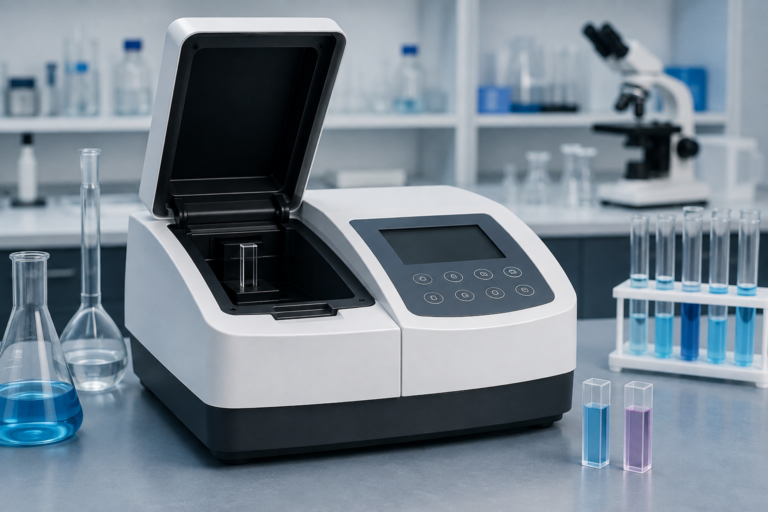
The most common use of quartz cuvettes is in UV-Vis spectrophotometers. The cuvette holds the liquid sample while the instrument measures how much light is absorbed at specific wavelengths.
Pharmaceutical Quality Control
Pharmaceutical laboratories use quartz cuvettes for analytical testing, assay development, dissolution-related analysis, purity checks, and routine quality control workflows.
Biotechnology and Life Sciences
Quartz cuvettes are often used in the analysis of proteins, DNA, RNA, enzymes, and other biological molecules, especially when absorbance is measured in the UV range.
Chemical Research
In chemical laboratories, quartz cuvettes support concentration measurements, kinetic studies, reaction monitoring, and material characterization.
Environmental and Industrial Testing
Quartz cuvettes are also used in laboratories that test water, chemicals, raw materials, finished products, and environmental samples.
Path Length: Why 10 mm Is the Standard
One of the most important specifications of a quartz cuvette is its path length. The path length is the distance the light travels through the sample.
The most common standard path length is 10 mm. This value is widely used because many absorbance calculations are based on a known and consistent optical path.
A standard 10 mm quartz cuvette is suitable for many routine UV-Vis applications. However, other path lengths may be required depending on the concentration of the sample, the sensitivity of the method, or the instrument configuration.
Shorter path lengths may be used for highly concentrated samples, while longer path lengths may be useful for low-concentration samples where increased sensitivity is needed.
How to Choose the Right Quartz Cuvette
Selecting the correct quartz cuvette is essential for reliable analytical results. Several factors should be considered before choosing a cuvette.
1. Wavelength Range
The cuvette must be suitable for the wavelength range used in the analysis. For UV measurements, it is important to choose a cuvette specifically designed for ultraviolet transmission.
2. Path Length
A 10 mm path length is the most common, but it is not always the only option. The correct path length depends on the concentration of the sample and the analytical method.
3. Sample Volume
Different cuvettes require different sample volumes. Standard cuvettes are suitable for routine volumes, while semi-micro and micro cuvettes are used when sample volume is limited.
4. Instrument Compatibility
The cuvette must physically fit the spectrophotometer. Dimensions, optical window height, and beam position should match the instrument’s cuvette holder.
5. Chemical Compatibility
The cuvette must be compatible with the solvents, reagents, and sample types used in the laboratory. Quartz is chemically resistant in many applications, but proper compatibility should always be checked.
6. Optical Quality
High-quality quartz cuvettes should have clean, polished optical windows and precise manufacturing tolerances. Poor optical quality can affect baseline stability, absorbance accuracy, and repeatability.
Common Types of Quartz Cuvettes
Quartz cuvettes are available in several configurations, depending on the application.
| Type | Typical Use |
|---|---|
| Standard quartz cuvette | Routine UV-Vis analysis |
| Micro quartz cuvette | Low sample volume measurements |
| Semi-micro quartz cuvette | Reduced volume with standard compatibility |
| Fluorescence quartz cuvette | Measurements requiring multiple optical windows |
| Stoppered quartz cuvette | Volatile samples or contamination-sensitive analysis |
| Flow-through quartz cuvette | Continuous monitoring or automated systems |
The correct type depends on the analytical workflow, sample availability, instrument type, and measurement technique.
Best Practices for Using Quartz Cuvettes
Even a high-quality quartz cuvette can produce poor results if it is not handled correctly. Proper use and maintenance are essential.
Recommended practices include:
- Handle the cuvette only by the frosted or non-optical sides.
- Avoid touching the optical windows.
- Make sure the cuvette is clean before each measurement.
- Remove bubbles from the sample before analysis.
- Fill the cuvette to the required level.
- Use the same orientation during repeated measurements.
- Inspect the optical windows for scratches or residue.
- Clean the cuvette immediately after use.
- Store the cuvette in a protective case.
Small scratches, fingerprints, dust, or dried residues can interfere with light transmission and affect the accuracy of the measurement.
Cleaning and Maintenance
Quartz cuvettes are reusable, but they require careful cleaning. The correct cleaning procedure depends on the sample and solvent used.
In general, the cuvette should be rinsed with a suitable solvent immediately after use. For aqueous samples, purified water may be sufficient. For organic samples, an appropriate solvent may be needed. After rinsing, the cuvette should be dried carefully without scratching the optical surfaces.
Abrasive materials should not be used. Strong cleaning agents should only be used when they are compatible with quartz and the laboratory’s safety procedures.
Proper maintenance helps extend the life of the cuvette and supports consistent analytical performance.
Why Cuvette Quality Matters in Analytical Measurements
The cuvette is part of the optical path of the instrument. This means it directly influences the light reaching the detector.
A low-quality or damaged cuvette can cause:
- Unstable absorbance readings
- Increased baseline noise
- Poor repeatability
- Light scattering
- Unwanted absorbance
- Inaccurate concentration calculations
- Reduced method reliability
For laboratories that rely on precise analytical results, choosing the right cuvette is not a minor detail. It is part of the complete measurement system.
Quartz Cuvettes in Professional Laboratory Workflows
Professional laboratories often work under strict requirements for accuracy, repeatability, documentation, and method reliability. In such environments, the selection of consumables and accessories is just as important as the selection of the instrument itself.
Quartz cuvettes are commonly used in workflows that require:
- Reliable UV transparency
- Repeatable absorbance measurements
- Compatibility with analytical methods
- Consistent optical performance
- Long-term laboratory use
For analytical laboratories, pharmaceutical QC teams, research facilities, and industrial testing labs, quartz cuvettes help support accurate and consistent spectrophotometric analysis.
Ophir Analytical is positioned as an experienced supplier and service provider for analytical laboratories, with a focus on analytical instruments, chromatography, spectroscopy, HPLC and GC columns, sample preparation, laboratory consumables, and professional service in Israel. The company’s positioning is built around high-quality analytical instruments, application support, and professional laboratory service since 1991.
Frequently Asked Questions About Quartz Cuvettes
What is a quartz cuvette used for?
A quartz cuvette is used to hold liquid samples during optical measurements, mainly in UV-Vis spectrophotometry. It allows light to pass through the sample so the instrument can measure absorbance or transmittance.
Why is quartz used instead of glass?
Quartz is used because it provides better transmission in the ultraviolet range. Glass is suitable for many visible-light measurements, but it is usually not ideal for UV applications.
What is the standard path length of a quartz cuvette?
The most common path length is 10 mm. This is the standard used in many UV-Vis methods and absorbance calculations.
Can quartz cuvettes be reused?
Yes. Quartz cuvettes are reusable when cleaned and stored properly. They should be handled carefully to avoid scratches, fingerprints, and contamination.
When should a laboratory choose a quartz cuvette?
A laboratory should choose a quartz cuvette when working with UV measurements, high-precision absorbance analysis, sensitive samples, or methods that require reliable optical performance.
Is “Cuuvette quartz” the correct term?
No. The correct professional term is quartz cuvette. However, “Cuuvette quartz” is sometimes used as a misspelled search term by users looking for quartz cuvettes.
Summary
A quartz cuvette is an essential component in UV-Vis spectroscopy and other optical laboratory measurements. Its main role is to hold the sample in a stable optical path while allowing accurate light transmission through the liquid.
Because quartz offers excellent transparency in the ultraviolet and visible ranges, quartz cuvettes are preferred for analytical applications that require precision, repeatability, and reliable optical performance.
When choosing a quartz cuvette, laboratories should consider wavelength range, path length, sample volume, instrument compatibility, chemical resistance, and optical quality. Correct handling, cleaning, and storage are also essential for maintaining measurement accuracy over time.
For professional laboratories, a quartz cuvette is more than a simple sample holder. It is a critical part of the analytical workflow and can directly affect the reliability of the final result.