
A Professional Guide to Selection, Performance, and Applications
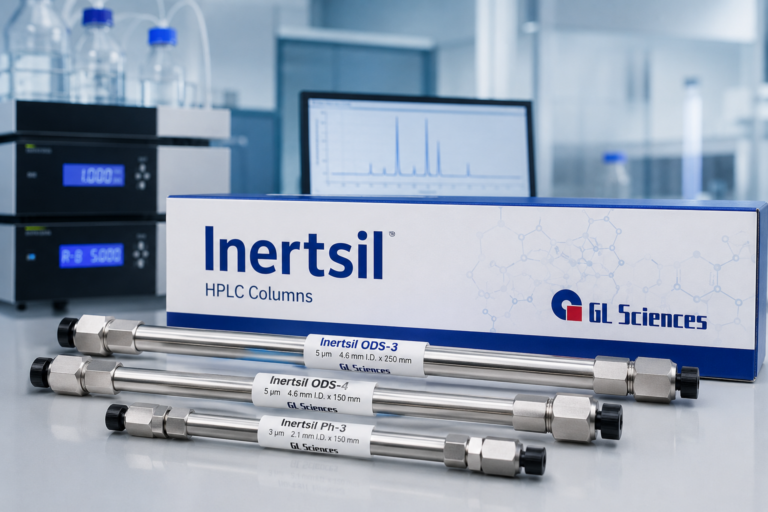
Inertsil is an established family of high-performance liquid chromatography columns developed by GL Sciences for analytical and preparative separation workflows. The product range includes several stationary-phase chemistries for reversed-phase chromatography, HILIC, normal-phase chromatography, size-exclusion applications, and other specialized separation modes.
Choosing the correct Inertsil column can have a major effect on chromatographic selectivity, analyte retention, peak shape, resolution, operating pressure, run time, and overall method robustness. For this reason, column selection should never be based only on the label “C18” or on column dimensions. The stationary-phase chemistry, silica properties, particle size, pore size, carbon loading, pH range, mobile phase, and chemical characteristics of the sample must all be considered.
What Is Inertsil?
Inertsil is a broad series of silica-based HPLC and LC/MS columns designed for different chromatographic separation mechanisms. Depending on the selected model, the bonded phase may include octadecyl groups for C18 separation, octyl groups for C8 separation, phenyl groups, diol groups, aminopropyl groups, or other specialized functionalities.
Inside an HPLC column, compounds interact with both the mobile phase and the stationary phase. Compounds that interact more strongly with the stationary phase generally remain in the column for longer periods, while compounds with weaker interactions are eluted earlier.
The purpose of selecting a suitable Inertsil column is therefore not simply to retain the sample. The objective is to create sufficient differences in retention between the target compound, impurities, degradation products, matrix components, or structurally related substances.
Why Inertsil Column Selection Matters
Two columns may both be classified as C18 and still produce noticeably different chromatograms. Differences in bonding density, carbon loading, silica surface area, end-capping, pore structure, and residual silanol activity can change retention times, selectivity, peak symmetry, and even the order in which compounds are eluted.
For example, Inertsil ODS-3 and Inertsil ODS-4 are both end-capped C18 columns with a USP L1 classification. However, ODS-3 has a reported carbon loading of 15%, while ODS-4 has a reported carbon loading of 11%. GL Sciences also notes that differences in the base silica and carbon loading can produce different selectivity for certain analytes.
Selecting an appropriate column may help a laboratory achieve:
- Improved resolution between critical peak pairs
- More symmetrical and narrower peaks
- Suitable retention of target compounds
- Shorter and more efficient analytical runs
- Better repeatability between injections
- More reliable quantitative results
- Improved compatibility with the selected mobile phase
- Greater method robustness during routine laboratory work
The column remains only one part of the chromatographic method. Mobile-phase composition, pH, buffer concentration, temperature, flow rate, injection volume, detector settings, sample solvent, and sample preparation must also be optimized.
Main Types of Inertsil Columns
The Inertsil range includes several stationary phases, each designed to provide a different retention profile or separation mechanism. Understanding these differences is essential during method development, troubleshooting, or method transfer.
Inertsil ODS-3
Inertsil ODS-3 is one of the best-known C18 phases in the Inertsil range. GL Sciences describes it as its most popular Inertsil phase and notes its continued use in long-established methods within pharmaceutical and contract research laboratories.
ODS-3 provides relatively strong hydrophobic retention compared with many commercially available ODS columns. Its high-surface-area silica can also support preparative loading while maintaining suitable peak shape. The analytical product range includes particle sizes from 2 to 10 µm, with a reported surface area of 450 m²/g, a pore size of 100 Å, end-capping, and a pH range of 2 to 7.5.
This column may be particularly relevant for:
- Established pharmaceutical methods
- Routine reversed-phase HPLC
- Compounds requiring relatively strong hydrophobic retention
- Methods already developed or validated with ODS-3
- Analytical and preparative chromatography
When replacing ODS-3 with another C18 column, laboratories should not assume that the alternative will produce identical selectivity, even when the USP classification and dimensions are the same.
Inertsil ODS-4
Inertsil ODS-4 is another C18 column, but its selectivity and operating characteristics differ from those of ODS-3. GL Sciences describes ODS-4 as a highly inert phase with stability under 100% aqueous mobile-phase conditions.
This characteristic can be valuable when highly aqueous initial conditions are required to retain relatively polar compounds in reversed-phase chromatography. ODS-4 is based on high-purity silica, is end-capped, has a USP L1 classification, and is available in 2, 3, and 5 µm particle sizes. Its stated pH range is 2 to 7.5.
Inertsil ODS-4 may be considered for:
- New reversed-phase method development
- Highly aqueous mobile phases
- Polar or moderately polar compounds
- Methods requiring high stationary-phase inertness
- Qualitative and quantitative HPLC analysis
GL Sciences recommends Inertsil ODS-4 or InertSustain C18 for new method development instead of the original general-purpose Inertsil ODS phase.
Inertsil Hybrid-C18
Inertsil Hybrid-C18 is a reversed-phase column based on hybrid organic-inorganic bonding technology. Its most significant characteristic is its broad stated pH range of 1 to 12, which is considerably wider than the 2 to 7.5 range specified for many traditional Inertsil silica-based phases.
The column is also compatible with 100% aqueous mobile phases and is designed for LC/MS, LC/MS/MS, and high-pressure LC systems. Available particle sizes include 1.7, 3.5, and 5 µm. The exact pressure and temperature limits depend on particle size, hardware, and operating pH.
Inertsil Hybrid-C18 may be suitable when:
- A method requires strongly acidic or basic conditions
- Mobile-phase pH is used to control analyte ionization
- Highly aqueous conditions are necessary
- LC/MS compatibility is important
- A method must operate outside the normal pH range of conventional silica columns
- High-pressure LC operation is required
A broad pH range provides greater flexibility, but the column should still be operated within the exact pressure and temperature limits specified for the selected format.
Inertsil C8-4
Inertsil C8-4 contains octyl, or C8, bonded groups rather than the longer octadecyl groups used in C18 columns. C8 phases generally provide lower hydrophobic retention than comparable C18 phases, making them useful when an analyte remains in a C18 column for too long.
GL Sciences states that C8-4 was designed to provide a separation pattern similar to that of ODS-4, potentially simplifying method transfer when reduced retention is required. It is end-capped, classified as USP L7, and available in 2, 3, and 5 µm particle sizes.
Inertsil C8-4 may be useful for:
- Highly hydrophobic compounds
- Methods with excessive retention on C18
- Reducing analytical run time
- Lowering the amount of organic solvent needed for elution
- Transferring an ODS-4 method to a less retentive phase
- Adjusting retention without completely changing the selectivity pattern
The reduction in retention must still be experimentally evaluated because the actual result depends on analyte structure, mobile-phase composition, temperature, and pH.
Inertsil Ph-3
Inertsil Ph-3 is a phenyl-bonded reversed-phase column. Phenyl stationary phases can provide a different selectivity profile from conventional C18 and C8 phases, especially for compounds containing aromatic structures or electronic differences that influence phenyl-related interactions.
GL Sciences describes Ph-3 as having phenyl groups directly bonded to high-purity silica. The column is intended to provide narrow, symmetrical peaks for polar compounds, including acidic and basic pharmaceutical substances. It is available in 2, 3, and 5 µm particle sizes and is classified as USP L11.
Inertsil Ph-3 may be considered for:
- Aromatic compounds
- Acidic and basic pharmaceutical substances
- Structurally related compounds that are difficult to separate on C18
- Methods requiring alternative reversed-phase selectivity
- Compounds producing insufficient resolution on alkyl-bonded phases
Phenyl columns should not be viewed only as less hydrophobic alternatives to C18. Their principal value is often the change in selectivity they can provide.
Inertsil HILIC
Inertsil HILIC is designed for hydrophilic interaction chromatography. HILIC is commonly considered when highly polar compounds show insufficient retention in conventional reversed-phase methods.
The Inertsil HILIC stationary phase contains chemically bonded diol groups. GL Sciences states that it is designed to provide suitable peak shape for neutral and basic compounds. In HILIC mode, increasing the concentration of organic solvent generally increases retention, which is the opposite of the usual trend in reversed-phase chromatography.
Inertsil HILIC may be appropriate for:
- Highly polar compounds
- Neutral and basic polar analytes
- Compounds with little or no retention on C18
- LC methods using high concentrations of acetonitrile
- Alternative separation of hydrophilic substances
HILIC method development requires careful control of water content, buffer concentration, equilibration time, injection solvent, and sample solubility. Small changes in these parameters may noticeably affect retention and repeatability.
Inertsil NH2
Inertsil NH2 uses an aminopropyl stationary phase and can provide a valuable alternative for compounds that are difficult to separate by reversed-phase chromatography.
GL Sciences identifies simultaneous sugar analysis and vitamin E analysis as examples of applications for aminopropyl phases. The company also states that Inertsil NH2 was designed to improve reproducibility and retention stability compared with conventional aminopropyl columns. It is available in 3 and 5 µm particle sizes and carries a USP L8 classification.
This phase may be considered for:
- Sugar analysis
- Selected vitamin analyses
- HILIC-type separation
- Normal-phase applications
- Samples requiring aminopropyl selectivity
Because aminopropyl phases have specific chemical characteristics, mobile-phase suitability and cleaning procedures should be confirmed before routine use.
Inertsil Diol
Inertsil Diol contains bonded dihydroxypropyl groups and is intended primarily for normal-phase separation. Its separation mechanism includes hydrogen-bonding interactions between the diol stationary phase and polar analytes.
Compared with a bare silica column, a diol phase may provide different retention and selectivity for acidic, basic, and neutral compounds. GL Sciences states that Inertsil Diol can also be washed with a fully aqueous eluent because nonspecific water adsorption has been reduced.
It may be useful for:
- Normal-phase chromatography
- Polar analytes
- Alternative selectivity to bare silica
- Compounds separated through hydrogen-bonding interactions
- Acidic and basic compounds requiring stable normal-phase retention
Comparison of Popular Inertsil Columns
| Inertsil model | Stationary phase | Main characteristic | Typical selection rationale |
|---|---|---|---|
| Inertsil ODS-3 | C18 | Relatively strong hydrophobic retention | Established methods and routine reversed-phase HPLC |
| Inertsil ODS-4 | C18 | High inertness and compatibility with fully aqueous mobile phases | New methods, polar compounds, and highly aqueous conditions |
| Inertsil Hybrid-C18 | Hybrid C18 | Broad pH range from 1 to 12 | Acidic or basic methods, LC/MS, and demanding conditions |
| Inertsil C8-4 | C8 | Lower hydrophobic retention than C18 | Faster elution of compounds retained too strongly on C18 |
| Inertsil Ph-3 | Phenyl | Alternative selectivity for aromatic and polar compounds | Critical pairs that are not resolved on C18 or C8 |
| Inertsil HILIC | Bonded diol | Retention of highly polar compounds in HILIC mode | Analytes with weak reversed-phase retention |
| Inertsil NH2 | Aminopropyl | Selectivity for sugars and other polar compounds | HILIC and selected normal-phase applications |
| Inertsil Diol | Diol | Hydrogen-bonding interactions in normal-phase mode | Alternative selectivity to bare silica |
The appropriate column cannot be selected from this table alone. Final selection should be supported by experimental screening with representative standards, impurities, and sample matrices. The summarized characteristics are based on the official specifications of the individual Inertsil phases.
How to Choose the Right Inertsil Column
A systematic selection process is more effective than choosing a column by brand familiarity or USP code alone.
Define the Objective of the Method
Start by identifying what the method must accomplish. A high-concentration assay does not necessarily require the same selectivity as an impurity or stability-indicating method.
Important questions include:
- Which compounds must be separated?
- Which peak pairs are considered critical?
- Are the compounds neutral, acidic, basic, or ionizable?
- What is the expected concentration range?
- Is the method intended for identification, assay, impurities, or purification?
- Which detector will be used?
- Is the method intended for research, development, or routine quality control?
- Must the method follow an existing pharmacopoeial or validated procedure?
Clear analytical objectives make it easier to select an appropriate stationary phase and avoid unnecessary method-development experiments.
Evaluate the Chemical Properties of the Analytes
Hydrophobic neutral compounds are commonly evaluated first on a C18 phase. However, a different starting point may be more appropriate when the analytes are highly polar, strongly aromatic, ionizable, or excessively retained.
A practical initial screening approach may include:
- ODS-3 for stronger reversed-phase retention
- ODS-4 for high inertness and aqueous compatibility
- C8-4 when C18 retention is excessive
- Ph-3 when aromatic or structural selectivity is required
- HILIC or NH2 when polar compounds are poorly retained in reversed phase
- Hybrid-C18 when the required pH is outside the range of conventional silica
Testing stationary phases with genuinely different selectivity is usually more informative than testing several nearly identical C18 columns.
Consider the Required Retention
Insufficient retention can result in analyte peaks appearing close to the solvent front or unresolved from matrix components. Excessive retention can create long run times, broad peaks, and unnecessarily high solvent consumption.
When retention is too weak, the laboratory may evaluate:
- A more retentive C18 phase
- A lower organic-solvent concentration
- An adjusted mobile-phase pH
- HILIC for highly polar compounds
- A longer column, where appropriate
When retention is too strong, possible options include:
- Inertsil C8-4
- A stronger mobile phase
- A shorter column
- A gradient method
- Higher temperature within the permitted operating range
Changes should be made systematically because retention and selectivity often change at the same time.
Match the Column to the Required pH
Mobile-phase pH affects both analyte ionization and stationary-phase stability. For ionizable compounds, changing pH can substantially alter retention, peak shape, and selectivity.
Many conventional Inertsil phases, including ODS-3, ODS-4, C8-4, Ph-3, HILIC, NH2, and Diol, have a stated operating range of pH 2 to 7.5. Inertsil Hybrid-C18 has a broader stated range of pH 1 to 12.
The permitted range should always be checked for the exact model, particle size, hardware, temperature, and method conditions. Operating near an extreme limit may affect column lifetime even when the nominal pH remains within the published range.
Select an Appropriate Particle Size
Particle size influences column efficiency and operating pressure. Smaller particles can provide higher efficiency and narrower peaks, but they generally create greater backpressure.
Common considerations include:
- 5 µm particles for conventional routine HPLC
- 3 or 3.5 µm particles for increased efficiency or shorter methods
- 2 or 1.7 µm particles for high-efficiency and UHPLC applications
- 10 µm particles for selected established or preparative methods
The HPLC or UHPLC system must be capable of operating safely at the expected pressure. Extra-column volume, tubing dimensions, detector cell volume, and injection volume also become increasingly important when short or narrow-bore columns are used.
Choose the Correct Length and Internal Diameter
A longer column can provide more theoretical plates and potentially better resolution, but it also increases pressure, run time, and solvent consumption.
A shorter column can improve speed when sufficient selectivity is already available. Narrower internal diameters may reduce solvent consumption and improve compatibility with LC/MS, but they require appropriate flow rates and low system dispersion.
Column dimensions should therefore be chosen according to:
- Required resolution
- Desired analysis time
- Instrument pressure capability
- Sample concentration
- Detector sensitivity
- Solvent-consumption goals
- Method-transfer requirements
Consider Existing and Validated Methods
When an established method specifies Inertsil ODS-3, replacing it with another C18 phase may change retention and resolution. Matching the USP classification is important, but it does not prove chromatographic equivalence.
Before replacing a column in a routine or validated method, the laboratory should evaluate:
- Retention times
- Relative retention
- Resolution
- Peak symmetry
- Theoretical plates
- Backpressure
- Quantitative recovery
- System-suitability results
- Performance with impurities and degradation products
Any method change should be managed according to the laboratory’s quality procedures and applicable regulatory requirements.
Common Applications of Inertsil Columns
Pharmaceutical Analysis
Inertsil columns are used in pharmaceutical and contract research environments for established methods, assay testing, impurity analysis, stability studies, and method development. GL Sciences specifically identifies ODS-3 as a widely used phase for long-established pharmaceutical methods, while Ph-3 is positioned for polar acidic and basic pharmaceutical compounds.
The most appropriate stationary phase depends on whether the method must separate an active ingredient, related substances, degradation products, preservatives, excipients, or multiple compounds in a combined formulation.
Food, Chemical, and Environmental Laboratories
Inertsil ODS-3V has been used in pharmaceutical, chemical, food, and environmental analysis since its introduction in 1994, according to GL Sciences. These fields may require analysis of vitamins, food ingredients, organic acids, environmental contaminants, preservatives, and other small molecules.
The sample matrix is especially important in these applications because fats, pigments, proteins, salts, and nonvolatile residues can affect column performance and chromatographic selectivity.
Research and Method Development
Research laboratories can use the variety of Inertsil chemistries to screen different separation mechanisms. Evaluating C18, C8, phenyl, HILIC, amino, and diol phases can reveal selectivity differences that cannot always be achieved by changing the mobile phase alone.
A structured screening strategy may reduce development time by identifying whether the main challenge is retention, selectivity, ionization, or unwanted secondary interaction.
Preparative Chromatography
GL Sciences offers preparative columns in several Inertsil stationary phases and dimensions. Preparative chromatography is used when the objective is not only to detect compounds but also to isolate and collect purified fractions.
Preparative column selection must consider loading capacity, solubility, selectivity, recovery, pressure, fraction purity, and the scale of the required purification.
Best Practices for Using Inertsil Columns
Use a Compatible Guard Column
A guard column can protect the analytical column from particulate matter and compounds that are strongly or irreversibly retained.
GL Sciences states that its Inertsil guard cartridges contain the same packing material used in the corresponding analytical columns. Matching the guard phase to the analytical phase helps preserve the intended selectivity while protecting the more expensive analytical column.
The guard cartridge should be inspected or replaced when:
- System pressure begins to increase
- Peak shape deteriorates
- Retention becomes unstable
- A contaminated sample has been injected
- Performance improves after removing the guard cartridge
Operate Within the Published Limits
The pH, pressure, temperature, and solvent limits differ between Inertsil models. A method that is acceptable for Hybrid-C18 may not be appropriate for a conventional ODS-3 or ODS-4 column.
Always check the current specification for the exact column before beginning method development or transferring a method. GL Sciences provides model-specific manuals for the InertSustain and Inertsil series.
Protect the Column Through Appropriate Sample Preparation
Samples containing suspended particles or insoluble material can block the inlet frit and increase backpressure. Complex matrices may also contain substances that accumulate on the stationary phase.
Appropriate sample preparation may include filtration, centrifugation, dilution, extraction, or matrix cleanup. The selected procedure should preserve the analytes while reducing the amount of material entering the chromatographic system.
Confirm Mobile-Phase and Sample-Solvent Compatibility
All mobile-phase components should remain fully miscible, and buffers should remain soluble throughout the method. The sample solvent should also be compatible with the initial mobile-phase conditions.
A sample dissolved in an excessively strong solvent may produce distorted, split, or broadened peaks, especially in highly aqueous reversed-phase methods and HILIC methods.
Follow the Correct Cleaning and Storage Procedure
Cleaning and storage requirements depend on the stationary phase, buffer, sample matrix, and mobile phase. Salt-containing buffers should not be allowed to precipitate inside the column.
Because cleaning procedures differ between C18, HILIC, amino, diol, and other phases, the official instructions for the exact Inertsil model should be followed rather than applying one universal procedure to every column.
Common Mistakes When Selecting an Inertsil Column
Treating Every C18 Column as Equivalent
ODS-3, ODS-4, and Hybrid-C18 are all C18 phases, but they have different silica materials, carbon loading, pH ranges, particle-size options, and selectivity profiles. A shared USP L1 classification does not make them identical.
Choosing Only by Particle Size
A smaller particle size can improve efficiency, but it cannot correct fundamentally unsuitable selectivity. Testing a different stationary-phase chemistry may produce a greater improvement than increasing column efficiency.
Ignoring the Sample Solvent
Even a suitable column can produce poor peak shape when the sample solvent is significantly stronger than the initial mobile phase or incompatible with the chromatographic mode.
Exceeding the Column’s pH Range
Repeated exposure to unsuitable pH conditions can damage the bonded phase or silica support. A broad-range column such as Hybrid-C18 should be evaluated when the method requires conditions outside the range specified for conventional Inertsil phases.
Replacing a Column Without Comparative Testing
A replacement column should be tested with all critical compounds, not only the primary analyte. An acceptable assay result does not prove that impurities, degradation products, or matrix peaks remain adequately separated.
Frequently Asked Questions About Inertsil
Is Inertsil a Single HPLC Column?
No. Inertsil is a family of HPLC and LC/MS columns containing multiple stationary-phase chemistries. The range includes C18, C8, phenyl, HILIC, amino, diol, silica, cyano, and specialized phases for different analytical requirements.
What Is the Difference Between Inertsil ODS-3 and ODS-4?
Both are end-capped C18 columns with a USP L1 classification. ODS-3 provides relatively strong hydrophobic retention and is widely used in established pharmaceutical methods. ODS-4 has lower reported carbon loading, high stationary-phase inertness, and compatibility with 100% aqueous mobile phases. The two columns can therefore produce different selectivity.
Which Inertsil Column Is Suitable for Highly Polar Compounds?
Inertsil HILIC may be a suitable starting point when highly polar compounds are not adequately retained by reversed-phase chromatography. Inertsil NH2, ODS-4, Hybrid-C18, or Ph-3 may also be evaluated depending on analyte ionization, functional groups, aromaticity, and the required separation mechanism.
Which Inertsil Column Can Operate Across a Broad pH Range?
Inertsil Hybrid-C18 has a stated operating range of pH 1 to 12. Many conventional Inertsil silica-based phases have a stated range of pH 2 to 7.5. Temperature and pressure restrictions should also be checked because they vary with operating conditions and column format.
Can Inertsil Columns Be Used with LC/MS?
Compatibility depends on the selected model, mobile phase, dimensions, hardware, and method conditions. Inertsil Hybrid-C18 is specifically described by GL Sciences as compatible with LC/MS and LC/MS/MS. Volatile mobile-phase additives and appropriate flow rates should be selected for mass-spectrometric detection.
How Can an Inertsil Column’s Working Life Be Extended?
Use appropriate sample preparation, prevent particulate contamination, remain within the specified operating limits, and follow the correct cleaning and storage instructions. A compatible Inertsil guard column can provide additional protection because it uses packing material matched to the analytical phase.
Can One Inertsil C18 Column Replace Another?
It may be possible, but equivalence should never be assumed. Compare retention, selectivity, peak shape, resolution, pressure, and system suitability using representative samples and critical impurities. Extra evaluation may be required when the original method is validated or pharmacopoeial.
Professional Support for Inertsil Column Selection in Israel
Selecting the correct Inertsil column requires more than matching a product name to an existing method. The laboratory should consider analyte chemistry, sample matrix, separation objectives, mobile-phase conditions, instrument pressure, detection method, and regulatory requirements.
Ophir Analytical supports laboratories in Israel with analytical instruments, HPLC column solutions, analytical application services, consumables, and professional service. The company has operated in the analytical laboratory field since 1991, providing an experienced local point of contact for laboratories that require practical guidance in matching analytical products to their applications.
For laboratories developing a new HPLC method, transferring an existing procedure, replacing a discontinued column, or troubleshooting poor chromatographic performance, professional column-selection support can reduce unnecessary testing and help identify the most suitable Inertsil phase for the analytical objective.