A Complete Selection Guide
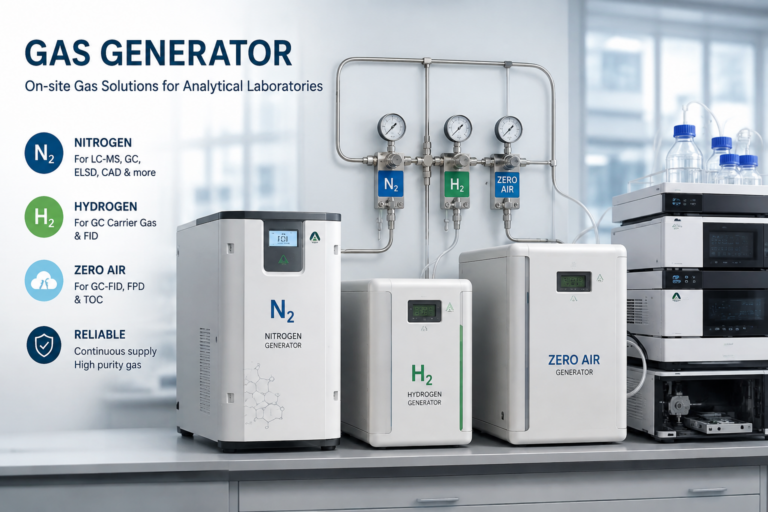
A gas generator provides laboratories with a controlled supply of gas directly at the point of use. Instead of depending entirely on delivered cylinders, the system produces nitrogen, hydrogen, zero air or another required gas on demand.
Laboratory gas generators are commonly matched to analytical applications such as GC, GC-MS, LC-MS, CAD, ELSD, ICP-MS, FT-IR, sample preparation and TOC analysis. The correct solution depends on the instrument, required gas purity, operating pressure, flow rate and expected laboratory workload.
For analytical laboratories, gas quality is not only a utility consideration. Stable pressure, suitable purity and sufficient flow can directly influence instrument operation, workflow continuity and the consistency of analytical measurements.
What Is a Gas Generator?
A gas generator is an instrument that produces a specific laboratory gas from an available source such as ambient air, compressed air or purified water.
Depending on the technology, the generator may separate nitrogen from compressed air, produce hydrogen through water electrolysis or remove hydrocarbons from compressed air to create zero air.
The main purpose is to provide a continuous and controlled gas supply that matches the requirements of the connected analytical instrument. Gas generators may be designed for one instrument, multiple instruments or a centralized laboratory gas network.
Common Laboratory Gases
The most common gas generator categories include:
- Nitrogen gas generators
- Hydrogen gas generators
- Zero air generators
- Ultra-high-purity gas generators
- Combined or multi-gas systems
Each gas performs a different analytical function. Nitrogen may be required as a source, nebulizing, drying, detector or make-up gas. Hydrogen can serve as a GC carrier gas or detector fuel gas. Zero air is frequently used to support combustion in flame-based GC detectors.
How Does a Gas Generator Work?
The operating principle depends on the gas being produced and the level of purity required.
Membrane Nitrogen Generation
A membrane nitrogen generator compresses atmospheric air and passes it through hollow-fibre membranes. Oxygen, moisture and other components of the air permeate the membrane at different rates, leaving a nitrogen-rich gas stream for the laboratory instrument.
Additional filtration stages may be included to remove particles and moisture before the air reaches the membrane. These stages help protect the separation system and support stable gas quality.
Membrane systems are frequently used when laboratories need a practical nitrogen supply across a defined range of flow rates and purity levels.
Pressure Swing Adsorption
Pressure Swing Adsorption, commonly known as PSA, also begins with compressed atmospheric air. The air passes through columns containing a carbon molecular sieve that selectively adsorbs oxygen and other molecules.
PSA systems normally alternate between two adsorption columns. While one column produces nitrogen, the other is depressurized and regenerated. This repeated pressure cycle enables continuous gas production.
PSA technology can be suitable when a laboratory requires higher nitrogen purity, larger flow capacity or a centralized supply. The ideal choice between membrane and PSA technology depends primarily on flow, purity and application requirements.
Hydrogen Generation by Electrolysis
A laboratory hydrogen generator commonly uses a Proton Exchange Membrane, or PEM, to produce hydrogen from purified water.
Inside the electrolyser cell, electrical energy separates water into hydrogen and oxygen. The membrane allows hydrogen ions to pass through while keeping the gas streams separated. The resulting hydrogen is purified and delivered to the connected analytical system as needed.
Because hydrogen is generated on demand, the system does not need to store the same large gas volume associated with a full high-pressure hydrogen cylinder. However, laboratories must still follow all manufacturer instructions, instrument requirements and site-specific safety procedures.
Zero Air Generation
Zero air is purified air from which hydrocarbons have been removed to a very low concentration. It is typically produced by passing compressed air through filtration and catalytic purification stages.
In gas chromatography, zero air is commonly used as flame support for Flame Ionization Detectors, known as FIDs, and Flame Photometric Detectors, known as FPDs. Low hydrocarbon content is important because background contaminants can interfere with sensitive measurements.
Why Do Analytical Laboratories Use Gas Generators?
The decision to install a gas generator is usually based on a combination of analytical, operational and financial considerations.
Continuous Gas Availability
A generator can provide gas on demand without waiting for cylinder deliveries or interrupting work to replace an empty cylinder.
This can be particularly valuable for laboratories operating LC-MS, GC or other instruments that consume gas continuously. A stable on-site source may help laboratories maintain scheduled analyses and reduce avoidable interruptions.
Consistent Pressure and Purity
Analytical instruments require gas that meets defined purity, pressure and flow specifications. These requirements can differ substantially between instrument types and even between models from the same manufacturer.
A properly selected generator is designed to deliver gas within the required operating range. Laboratories should never select a system based only on its advertised gas type. The complete specification must match the connected instrument.
Reduced Cylinder Handling
Gas cylinders require ordering, delivery, storage, movement, regulator management and periodic replacement. An on-site generator can reduce many of these logistical tasks.
This may be especially beneficial in laboratories with limited storage space, high gas consumption or strict workflow schedules.
Greater Control Over Gas Supply
On-site generation gives the laboratory more direct control over gas availability. It reduces dependence on delivery schedules and helps prevent situations in which analytical work is delayed because replacement cylinders have not arrived.
The generator still requires appropriate preventive maintenance, filters, servicing and operating checks. It should therefore be treated as an important part of the analytical infrastructure rather than as a maintenance-free accessory.
Potential Long-Term Cost Benefits
A laboratory gas generator normally involves a higher initial investment than a single cylinder. However, the lifetime calculation may be more favourable when the laboratory has regular or high gas consumption.
A realistic cost comparison should include:
- Cylinder rental
- Gas refills
- Delivery charges
- Administrative time
- Cylinder storage
- Regulator replacement
- Staff time for cylinder changes
- Generator electricity consumption
- Preventive maintenance
- Compressor servicing
- Replacement filters and components
The economic result depends on local gas prices, operating hours, gas consumption and the expected service life of the generator.
Main Types of Laboratory Gas Generators
Selecting the correct gas is the first stage of the decision process. The gas must match the instrument function, detector and analytical method.
Nitrogen Gas Generator
A nitrogen gas generator produces nitrogen from compressed atmospheric air using membrane or PSA technology.
Nitrogen generators are used in applications that may include:
- LC-MS
- GC and GC-MS
- Charged Aerosol Detection
- Evaporative Light Scattering Detection
- Sample evaporation
- Solvent evaporation
- Instrument purging
- Sample preparation
- Selected spectroscopy applications
The required purity is application-dependent. A nitrogen specification that is suitable for one instrument may be unsuitable for another.
For example, analytical equipment manufacturers may specify separate nitrogen requirements for source gas, collision gas or other internal functions. The gas supply must therefore be checked against the official installation documentation for the exact instrument.
Hydrogen Gas Generator
A hydrogen gas generator produces high-purity hydrogen from water, commonly through PEM electrolysis.
In analytical laboratories, hydrogen may be used as:
- Carrier gas for GC
- Fuel gas for Flame Ionization Detectors
- Fuel gas for Flame Photometric Detectors
- Collision or reaction gas in selected applications
Hydrogen can be considered as an alternative carrier gas for some GC and GC-MS methods. However, changing from helium to hydrogen is not automatically suitable for every instrument or method. The laboratory must evaluate instrument compatibility, detector configuration, column selection, method parameters and the manufacturer’s safety requirements before making the change.
Zero Air Generator
A zero air generator supplies air with extremely low hydrocarbon contamination.
It is mainly relevant when the analytical system requires clean combustion air or when trace hydrocarbons in ordinary compressed air could create an unwanted background signal.
Typical applications include:
- GC-FID
- GC-FPD
- Total Organic Carbon analysis
- Hydrocarbon-sensitive measurements
- Selected calibration and environmental applications
The required hydrocarbon limit should always be verified against the detector or method specification.
Multi-Gas Generator
A multi-gas system can provide more than one gas from a single platform or coordinated generator configuration.
For example, a GC laboratory may require hydrogen, nitrogen and zero air for carrier, make-up and detector functions. A combined system can simplify laboratory planning, but every outlet must independently meet the required flow, pressure and purity.
Gas Generator Applications in Analytical Laboratories
A gas generator should be selected according to the application rather than according to a general product category.
Gas Chromatography and GC-MS
GC laboratories may require several gases for different purposes:
- Carrier gas transports the sample through the analytical column.
- Fuel gas supports flame-based detectors.
- Zero air supports detector combustion.
- Make-up gas optimizes detector flow conditions.
Hydrogen, nitrogen and zero air generators are widely available for GC and GC-MS configurations. The exact gas combination depends on the detector, column, instrument model and analytical method.
LC-MS
Many LC-MS systems consume nitrogen at relatively high flow rates. The gas may be used for nebulization, desolvation, drying, sheath gas, auxiliary gas or other instrument functions.
A generator for LC-MS must be sized according to the maximum required flow and pressure, not only the average operating demand. Where one generator supplies multiple instruments, total peak consumption must be calculated carefully.
HPLC with CAD or ELSD Detection
Charged Aerosol Detectors and Evaporative Light Scattering Detectors require a stable gas supply for nebulization and evaporation.
Thermo Fisher notes that nitrogen generators can provide an on-demand, uninterrupted supply of dry nitrogen for CAD systems. It also emphasizes that the gas source must meet the detector’s specified pressure, purity and contamination limits.
Sample Preparation and Solvent Evaporation
Nitrogen is frequently used for sample concentration, evaporation and preparation workflows. In these applications, laboratories may need lower purity than a highly sensitive mass spectrometry system but a higher total flow.
The generator should therefore be selected according to both gas quality and the number of evaporation positions operating simultaneously.
Spectroscopy and Other Analytical Techniques
Gas generators may also support ICP-MS, FT-IR, circular dichroism, TOC analysis and additional analytical applications.
Because each technique uses gas differently, laboratories should avoid assuming that one nitrogen generator can serve every instrument without a detailed capacity and compatibility assessment.
How to Choose the Right Gas Generator
The best system is not necessarily the generator with the highest purity or largest flow. It is the generator that reliably meets the real requirements of the laboratory.
1. Identify the Required Gas
Start by confirming whether the instrument requires nitrogen, hydrogen, zero air, dry air or a combination of gases.
The answer should come from the official instrument manual, site preparation guide or qualified technical representative.
2. Verify Purity Requirements
Purity requirements may refer to:
- Overall gas purity
- Maximum oxygen content
- Maximum moisture content
- Hydrocarbon concentration
- Particle contamination
- Dew point
- Oil-free air requirements
A high percentage alone does not provide the complete specification. For sensitive applications, contamination limits can be as important as the stated purity.
3. Calculate Maximum Flow
Determine the maximum flow required during normal operation, startup, tuning, cleaning and simultaneous instrument use.
When one generator supplies several instruments, include:
- Combined peak demand
- Future instrument expansion
- Leakage allowance
- Required reserve capacity
- Pressure losses in the gas line
Selecting a generator too close to its maximum capacity may lead to pressure instability when laboratory demand increases.
4. Confirm Operating Pressure
The generator must deliver sufficient pressure at the instrument inlet after accounting for regulators, tubing length, fittings and shared gas lines.
Flow and pressure must be evaluated together. A generator may offer sufficient nominal flow but fail to maintain that flow at the pressure required by the instrument.
5. Check Instrument Compatibility
Confirm that the proposed generator is suitable for the specific instrument brand, model and application.
This is especially important for:
- LC-MS systems with high nitrogen consumption
- GC-MS methods being converted to hydrogen
- Detectors with strict hydrocarbon limits
- Instruments requiring multiple gas purity levels
- Validated pharmaceutical or quality-control methods
6. Assess the Compressor Configuration
Some generators include an integrated compressor. Others require a suitable external compressed-air supply.
An integrated system can simplify installation when the laboratory does not have central compressed air. A compressorless generator may require less internal mechanical maintenance, but the external air supply must meet the generator’s quality and pressure requirements.
7. Evaluate the Laboratory Environment
The site assessment should consider:
- Available floor or bench space
- Electrical requirements
- Heat output
- Ventilation
- Noise
- Drainage or condensate management
- Access for service
- Distance from the analytical instrument
Installation should always follow the generator and instrument manufacturers’ instructions.
8. Review Maintenance and Technical Support
A gas generator requires planned maintenance to protect performance and service life.
Depending on the system, maintenance may include:
- Filter replacement
- Compressor servicing
- Water quality checks
- Leak testing
- Preventive inspections
- Cleaning or replacement of separation components
- Verification of pressure and flow
- Gas quality testing where required
The availability of qualified technical service should be considered before purchasing the equipment, particularly when the generator supports a critical or continuously operating instrument.
Gas Generator vs Gas Cylinders
| Selection Factor | Gas Generator | Gas Cylinders |
|---|---|---|
| Gas availability | Produced on demand | Limited to cylinder capacity |
| Initial investment | Usually higher | Usually lower |
| Ongoing logistics | Reduced delivery dependence | Regular ordering and replacement |
| Gas storage | Limited on-site production volume | Large volume stored under high pressure |
| Maintenance | Requires scheduled service | Regulator and cylinder management |
| Operating cost | Can be lower at regular consumption | Can increase with frequent use |
| Laboratory space | Requires installation space | Requires cylinder storage and securing |
| Supply interruption | Mainly related to service or power | Related to empty cylinders and delivery |
| Expansion | Limited by generator capacity | Additional cylinders can be added |
| Best fit | Regular, predictable gas demand | Low or occasional gas consumption |
Neither solution is automatically correct for every laboratory. Cylinders may remain practical for low-consumption or backup applications, while a generator may be more appropriate for instruments that operate daily and consume significant gas volumes.
Common Gas Generator Selection Mistakes
Choosing According to Gas Type Alone
Two generators may both produce nitrogen but have very different purity, flow and pressure capabilities. The instrument specification must guide the selection.
Ignoring Peak Consumption
Average consumption does not always represent startup, tuning or simultaneous instrument demand. The generator must support maximum expected use.
Overlooking Contamination Specifications
Gas purity stated as a percentage may not describe moisture, hydrocarbon or particle contamination. These parameters can be critical for analytical performance.
Assuming Every Instrument Accepts Hydrogen
Hydrogen may be suitable for many GC applications, but conversion requires a method-specific and instrument-specific review. Hardware changes, safety functions or method redevelopment may be necessary.
Failing to Plan for Maintenance
A generator supports critical laboratory equipment and should be included in the preventive maintenance schedule. Lack of service planning can turn a minor issue into unplanned analytical downtime.
Using Inappropriate Tubing or Installation Components
Tubing, filters, regulators and fittings must be compatible with the required gas and cleanliness level. Installation work should be performed according to the official technical instructions.
Frequently Asked Questions About Gas Generators
What Is the Main Purpose of a Gas Generator?
A gas generator produces nitrogen, hydrogen, zero air or another gas at the laboratory site. It is used to supply analytical instruments without relying exclusively on delivered cylinders. The generator must be selected according to the instrument’s required gas purity, pressure, flow and contamination limits.
Is a Gas Generator Suitable for GC?
Yes. GC laboratories may use generators for carrier gas, detector fuel, make-up gas and zero air. The correct configuration depends on the detector, analytical column, method and instrument model. Hydrogen, nitrogen and zero air are among the most common gases generated for GC applications.
Can a Gas Generator Supply an LC-MS System?
A properly sized nitrogen generator can supply many LC-MS systems. The generator must meet the maximum flow, pressure and purity specified by the LC-MS manufacturer. High-flow instruments or laboratories operating several systems may require a larger generator or centralized configuration.
What Is the Difference Between a Membrane and PSA Nitrogen Generator?
A membrane generator separates air through hollow fibres that allow gas components to permeate at different rates. A PSA generator uses pressurized columns containing a carbon molecular sieve. Membrane and PSA systems offer different combinations of flow, purity, cost and capacity.
Can One Generator Supply Multiple Instruments?
Yes, provided the generator can maintain the required purity, pressure and total flow when all connected instruments are operating at maximum demand. The gas distribution system must also be designed to prevent unacceptable pressure losses or contamination.
Does a Gas Generator Require Maintenance?
Yes. Maintenance requirements depend on the technology and whether the unit includes a compressor. Filters, compressor components, water quality, gas pressure and other operating parameters may require periodic inspection or replacement.
Is a Gas Generator More Economical Than Cylinders?
It can be more economical for laboratories with regular or high gas consumption. The correct comparison should include purchase price, maintenance, electricity, cylinder rental, gas refills, deliveries, staff time and the operational cost of interrupted analyses.
How Should a Laboratory Select the Correct Generator?
The laboratory should review the exact instrument specifications, calculate maximum gas demand, define purity and pressure requirements, assess the installation environment and confirm technical support availability. Final compatibility should be verified with qualified instrument and gas-system specialists.
Professional Gas Supply Planning for Analytical Workflows
A gas generator can provide a dependable and efficient supply of nitrogen, hydrogen or zero air for demanding analytical applications. Its effectiveness, however, depends on correct technical matching.
Purity, flow and pressure should be evaluated together with instrument compatibility, laboratory capacity, service requirements and future expansion. A carefully selected generator can support workflow continuity, reduce cylinder logistics and provide the stable gas conditions required by modern analytical equipment.
Ophir Analytical has supported laboratories in Israel with analytical instruments, application services and professional technical guidance since 1991. When evaluating gas supply for GC, GC-MS, LC-MS or another analytical workflow, professional application matching can help ensure that the selected solution fits both the instrument and the laboratory’s operating needs.