A Practical Guide for Analytical Laboratories
A spectrophotometer is one of the most widely used analytical instruments for measuring how a sample interacts with light. It is commonly used in quality control, research, pharmaceutical, chemical, environmental, industrial, and academic laboratories for quantitative and qualitative analysis.
By measuring the amount of light absorbed or transmitted by a sample at specific wavelengths, a spectrophotometer can help laboratories determine concentration, monitor reactions, evaluate material properties, and support repeatable analytical workflows.
For laboratories choosing spectroscopy equipment, however, the measurement principle is only part of the decision. Wavelength range, sample type, sensitivity, optical configuration, software, throughput, and application requirements can all influence which instrument is most suitable.
What Is a Spectrophotometer?
A spectrophotometer is an analytical instrument that measures the intensity of light before and after it passes through or interacts with a sample.
The instrument compares the amount of incident light with the amount of transmitted or absorbed light at selected wavelengths. This measurement can then be used to obtain information about the composition or concentration of the sample.
In many laboratory applications, the relationship between absorbance and concentration is evaluated according to the Beer-Lambert principle, making spectrophotometry particularly useful for quantitative analysis.
How Does a Spectrophotometer Work?
Although instrument designs vary, a typical spectrophotometer contains several important components.
Light Source
The light source provides radiation across the required wavelength range. The exact source depends on the type of spectroscopy and the analytical application.
Wavelength Selection
A monochromator, filter, or similar optical component isolates the wavelength or wavelength range required for the measurement.
Accurate wavelength selection is important because different compounds absorb light differently across the electromagnetic spectrum.
Sample Compartment
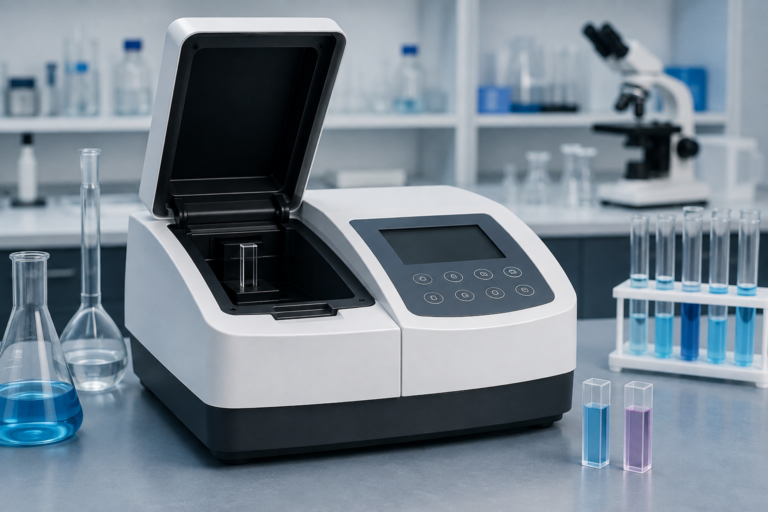
The sample is placed in a suitable holder, often a cuvette for liquid analysis.
The material and optical characteristics of the sample holder should be compatible with the wavelength range being used.
Detector
After the light interacts with the sample, a detector measures the remaining light intensity.
The instrument converts this signal into analytical data such as absorbance, transmittance, or concentration.
Data Processing
Modern instruments may include software for spectral scanning, calibration curves, quantitative measurements, method storage, data analysis, and reporting.
For routine QC environments, software usability and repeatable method execution can be as important as the optical specifications of the instrument.
What Is a UV-Vis Spectrophotometer?
A UV-Vis spectrophotometer measures light absorption primarily in the ultraviolet and visible regions of the electromagnetic spectrum.
UV-Vis spectroscopy is widely used because many compounds absorb light at characteristic wavelengths. By monitoring that absorption, laboratories can perform both qualitative observations and quantitative measurements.
Common applications can include:
- Concentration determination
- Reaction monitoring
- Purity assessment
- Chemical analysis
- Pharmaceutical quality control
- Biological and biochemical analysis
- Research applications
- Routine laboratory measurements
The exact suitability of UV-Vis analysis depends on the sample, analyte, concentration range, measurement objective, and analytical method.
Spectrophotometer Applications in the Laboratory
The versatility of spectrophotometry makes it suitable for many types of analytical laboratories.
Pharmaceutical Quality Control
Pharmaceutical laboratories may use spectrophotometric techniques for identification, assay-related measurements, concentration analysis, dissolution-related analytical workflows, and routine quality control.
Instrument selection should always be matched to the validated method and laboratory requirements.
Research Laboratories
Academic and research laboratories often require flexible analytical instruments capable of working with different sample types and experimental conditions.
A suitable system may support wavelength scans, kinetic measurements, quantitative analysis, and multiple method configurations.
Chemical and Industrial Laboratories
Industrial laboratories may use spectrophotometry for raw material testing, process monitoring, finished-product analysis, formulation development, and quality assurance.
In routine industrial environments, reliability and instrument uptime are particularly important considerations.
Environmental Analysis
Spectrophotometric techniques can also support the determination of selected substances in water and environmental samples after appropriate sample preparation and method development.
The quality of sample preparation can significantly influence analytical repeatability and measurement reliability.
Spectrophotometer vs Spectrometer – What Is the Difference?
The terms are sometimes used interchangeably, but they can refer to different types of analytical systems.
A spectrometer is a broad term for an instrument that measures properties of light or other electromagnetic radiation across a spectrum.
A spectrophotometer specifically measures light intensity in relation to wavelength and is commonly used to determine absorbance or transmittance.
In practical laboratory purchasing, the most important consideration is not terminology alone. The instrument should match the required analytical technique, sample type, sensitivity, wavelength range, and workflow.
Single-Beam vs Double-Beam Spectrophotometers
One important consideration when evaluating a system is its optical configuration.
Single-Beam Systems
A single-beam instrument measures the reference and sample sequentially.
These instruments may offer a relatively straightforward configuration and can be suitable for many routine laboratory measurements.
Double-Beam Systems
A double-beam system divides the light into sample and reference paths.
This configuration can help compensate for changes in source intensity and may provide advantages for applications requiring extended measurements or increased baseline stability.
The best choice depends on method requirements rather than on instrument architecture alone.
How to Choose a Spectrophotometer
Choosing the right analytical instrument should begin with the application rather than with a specification sheet.
1. Define the Wavelength Range
Determine whether the laboratory requires visible measurements, UV-Vis capability, or another spectroscopy technique.
The wavelength requirements should match the compounds and analytical methods used in the laboratory.
2. Consider the Sample Type
Different instruments and accessories may be required for:
- Liquid samples
- Small-volume samples
- Highly absorbing solutions
- Biological samples
- Specialized sample holders
- Routine QC measurements
Sample characteristics should be defined before selecting the system.
3. Determine the Required Sensitivity
The expected concentration range and absorbance values influence the required optical performance.
Low-concentration measurements may require different performance characteristics than routine measurements of relatively concentrated samples.
4. Evaluate Laboratory Throughput
A laboratory processing a large number of samples each day has different workflow requirements from a research laboratory running occasional measurements.
Consider:
- Number of samples
- Measurement time
- Automation requirements
- Method recall
- Data handling
- Reporting requirements
5. Review Software and Data Management
Software can significantly affect day-to-day instrument usability.
Important features may include calibration curves, spectral scanning, quantitative methods, kinetic analysis, method storage, export capabilities, and reporting.
6. Consider Service and Application Support
Specifications alone do not guarantee successful laboratory implementation.
Professional support can be important when selecting an instrument, matching it to an application, installing the system, defining workflows, and troubleshooting analytical performance.
Why Sample Preparation Matters
Reliable spectrophotometric analysis begins before the sample enters the instrument.
Improper sample preparation can introduce errors caused by:
- Contamination
- Incorrect dilution
- Turbidity
- Particles
- Matrix effects
- Inconsistent sample handling
- Incorrect blank preparation
A suitable sample preparation workflow improves repeatability and helps ensure that the measurement reflects the analytical target rather than preparation-related variation.
For this reason, spectroscopy should be viewed as part of the complete analytical workflow rather than as an isolated measurement step.
Accuracy, Repeatability and Method Suitability
When evaluating a spectrophotometer, laboratories should avoid choosing solely according to maximum specifications.
The instrument must be appropriate for the actual method.
Important considerations include:
- Wavelength accuracy
- Wavelength repeatability
- Photometric accuracy
- Photometric repeatability
- Stray light
- Spectral bandwidth
- Baseline stability
- Measurement range
- Sample compatibility
The importance of each parameter depends on the application.
A routine QC method may prioritize repeatability, straightforward operation, and method consistency, while a research laboratory may prioritize flexibility and advanced spectral capabilities.
Spectrophotometry as Part of an Analytical Workflow
Spectrophotometry is often one part of a broader analytical laboratory environment.
Depending on the laboratory, it may complement technologies and workflows involving:
- Chromatography
- HPLC
- UPLC
- GC
- GC-MS
- LC-MS
- Sample preparation
- Pharmaceutical dissolution testing
- Tablet physical testing
- Other spectroscopy techniques
Choosing analytical instrumentation as part of a complete workflow can help laboratories improve method suitability, data consistency, productivity, and operational reliability.
Spectroscopy Solutions and Professional Laboratory Support
Ophir Analytical has been active in the analytical laboratory field since 1991, with a focus on high-quality analytical instruments, analytical application services, professional service, chromatography, spectroscopy, sample preparation, laboratory consumables, and related analytical solutions.
For laboratories evaluating a spectrophotometer or other spectroscopy equipment, the selection process should begin with the analytical requirement: the sample, measurement objective, wavelength range, sensitivity, throughput, and existing laboratory workflow.
Professional application guidance can help ensure that the selected analytical solution fits the actual laboratory requirement rather than simply meeting a generic list of specifications.
Frequently Asked Questions About Spectrophotometers
What does a spectrophotometer measure?
A spectrophotometer measures how much light a sample absorbs or transmits at selected wavelengths. The resulting data can be used for concentration measurements, spectral analysis, quality control, reaction monitoring, and other analytical laboratory applications.
What is a spectrophotometer mainly used for?
It is commonly used for quantitative and qualitative laboratory analysis. Applications can include chemical analysis, pharmaceutical QC, biological research, environmental testing, concentration determination, and routine laboratory measurements.
What is the difference between absorbance and transmittance?
Transmittance represents the proportion of incident light that passes through a sample. Absorbance describes the amount of light absorbed by the sample. Both values are related and can provide useful analytical information depending on the method.
Is UV-Vis suitable for every sample?
No. UV-Vis spectrophotometry is suitable when the analyte or a resulting chemical species absorbs within the relevant ultraviolet or visible wavelength range. Sample characteristics, concentration, matrix effects, and the analytical objective must all be considered.
What should a laboratory check before buying a spectrophotometer?
The laboratory should define the required wavelength range, sample types, detection requirements, throughput, optical configuration, software needs, accessories, method requirements, and availability of professional technical and application support.
Why is professional support important when selecting analytical equipment?
Analytical instrument performance depends on the relationship between the instrument, sample, method, and workflow. Professional guidance can help laboratories evaluate method suitability, instrument configuration, sample handling requirements, and the practical requirements of routine laboratory operation.
Selecting the Right Spectrophotometer for Your Laboratory
The right spectrophotometer is not necessarily the instrument with the longest specification list. It is the system that provides the required analytical performance for the laboratory’s samples, methods, workload, and quality requirements.
Before selecting spectroscopy equipment, laboratories should clearly define the analytical objective, understand the sample characteristics, evaluate performance requirements, and consider the complete workflow from sample preparation to data reporting.
For laboratories in Israel looking for analytical instruments, spectroscopy solutions, application guidance, or professional laboratory support, Ophir Analytical provides an experienced point of contact for discussing analytical requirements and identifying an appropriate solution.